
Editorial
The superyacht industry is finally taking crew welfare seriously. Here’s what that means in practice.
Is superyacht management finally getting crew welfare right?

For five years, Kayleigh Liddell has been making the same argument: that superyacht management companies need to think about crew the way good employers think about people. For most of those years, the response was polite scepticism at best.
But this April, something changed.
At the 2026 Improving Yacht Crew Retention, Development & Welfare Conference in Nice—an event Hill Robinson has supported since its founding year—Kayleigh chaired a panel on management’s role in retaining crew, and moderated a workshop on handling the aftermath of critical incidents on board. She has attended since the beginning, but this year, she noticed a different atmosphere in the room.
“It wasn’t as anti-management as it has been in previous years,” she says. “There was a lot more talk about collaboration, about working together to create consistent standards. And a lot more hope.”
So, what does it actually mean for a management company to take crew welfare seriously?
Crew and management: no longer so tense?
The Crew Welfare Conference has always had an edge to it. As one of yachting’s dedicated forums on crew welfare, it has historically provided a space where frustrations with superyacht crew management could surface openly—sometimes uncomfortably so. That tension, Kayleigh says, has been part of its value.
This year felt different. Partly, she thinks, because of who was in the room.
“There were a lot more crew this year, which made a huge difference,” she says. “The stories they shared were insightful, sometimes emotional, and really helped to put everything into perspective.”
Some of those crew were there thanks to Hill Robinson’s own Crew Voices Project: an initiative that funds crew attendance at industry events, removing the financial and logistical barriers that too often keep the people most affected by these conversations out of the room.
More crew voices led to greater clarity. Rather than management and crew talking past each other, the conversation turned toward what consistent standards might look like across the industry, and who is responsible for setting them. Yacht crew retention, it became clear, is a people problem as much as an operational one—and it requires a people-centred response.
The question of responsibility came up repeatedly. The conference acknowledged that captains have been under increasing pressure to develop leadership skills that go beyond what the STCW requires, recognising that managing people demands a different kind of competence than managing a vessel. The discussion this year pushed further: should the same expectation apply to those working within management companies themselves? And if so, what would a management qualification look like?
These are not comfortable questions for an industry that has traditionally measured professional credibility through operational experience, but they’re the right ones.
Superyacht crew management is becoming an HR discipline
The shift in how superyacht crew management is understood—not just as an operational function, but as a people function—was one of the conference’s defining themes. Kayleigh chaired a panel on exactly this: management’s role in retaining crew, and the evolving responsibilities that come with it.
“We discussed the different responsibilities between employers and managers,” she says, “and how management has developed to become more HR focused—with people taking responsibility for the operational and the more personal sides of management.”
The distinction is an important one. For much of yachting’s history, management has been measured by its ability to keep vessels compliant, crewed, and running. Crew welfare sat somewhere adjacent to that—important, but rarely central. What the conference made clear is that how crew are supported, communicated with, onboarded, and developed directly affects whether they stay in the long term.
The conversation extended to a gap that often goes unacknowledged: sub-500GT yachts. Smaller vessels are less likely to work with a management company, and crew on board frequently report feeling less supported as a result, particularly during critical incidents, when having someone experienced ashore to turn to makes a significant difference. “They all have crew,” Kayleigh notes. “The difference is the numbers.”
There is a growing call for a more connected, supportive service for crew, she says, one that addresses physical and mental welfare, sets clear policies, and treats onboarding and crew handbooks as serious professional tools rather than administrative formalities.
“This is the foundation of Crew Services,” she explains. “Why we brought together recruitment, training, and employment—so we could take care of the entire crew journey.” In practice, that means an employment department capable of providing a HR service comparable to those found onshore, a commissioned helpline with ISWAN—making Hill Robinson the first and only yacht management company to offer this—and a collaboration between the Academy and Seas the Mind that has trained over 500 crew in mental health awareness.
Hill Robinson’s Academy Online reflects part of this thinking, recognising that developing leadership skills beyond what STCW requires needs to be supported with structured, accessible development pathways.
But the wider shift, Kayleigh argues, has to come from management companies being willing to lead it.
When things go wrong, critical incident management matters
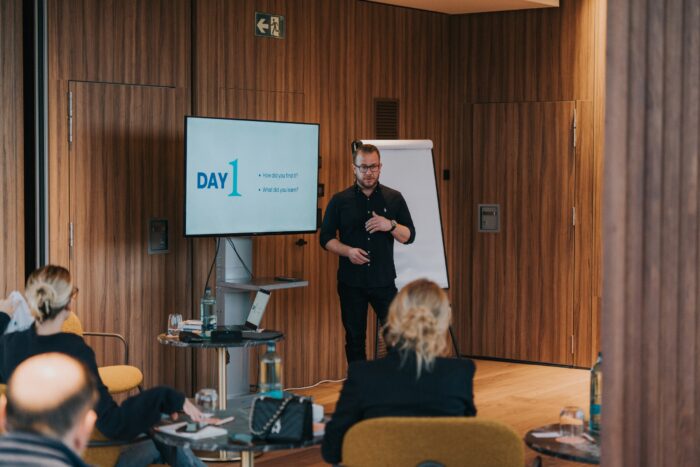
The conference also turned its attention to what happens when something goes wrong. One of the workshop sessions Kayleigh moderated focused on critical incident aftermath; specifically, how crew are supported psychologically once the immediate emergency has passed.
What emerged was a picture the industry rarely examines openly.
“The workshop mainly focused on the aftermath from a crew psychological impact perspective,” she says, “and the effects of social media in the aftermath.”
That second element—social media—is underappreciated as a compounding factor in critical incident management on yachts. In the immediate aftermath of a serious event, crew members may be processing trauma at the same time as managing their digital presence, fielding messages from family, or encountering coverage of the incident online. A management company that has not thought about this in advance is poorly placed to support them when it matters most.
The workshop was designed to move beyond diagnosis to action, gathering conclusions from each group that the industry could actually take forward. Critical incident management on yachts is not something that can be improvised in the moment. Preparation, policy, and a clear chain of pastoral support are what determine whether crew feel held or abandoned when the worst happens.
“It’s not enough to check in after the fact. What really matters is having a solid procedures in place, with clear communication pathways and people prepared to step in and share the information required,” Kayleigh explains. “Psychologically, it’s about collaborating and providing options. Managers do not—and shouldn’t —offer counselling. We’re not trained for that, so offering appropriate support to the crew and managers dealing with the incident is essential. Shoreside teams too, who are often affected by these incidents too.”
Why investing in crew is just good business
The case for taking crew welfare seriously is, above all, a human one. But it’s also a commercial one, and it is a case that management companies are increasingly being asked to make clearly to owners.
“Clients are more aware that they need to invest in their crew,” says Kayleigh. “But when it comes down to the numbers, we really need to start communicating that investing in your crew is both the right thing to do and the smart thing to do.”
Crew turnover is expensive: in recruitment costs, in lost institutional knowledge, in the disruption of re-crewing a vessel mid-season. Retaining experienced crew is a direct contribution to the smooth, compliant running of a yacht. Owners who treat crew welfare as a cost to be managed are, in many cases, creating a more expensive problem further down the line.
“For me, it’s the right thing to do. The smart thing too! You invest millions in your vessel to keep it running. You should do the same for the people on board because they’re the ones taking care of that very expensive vessel, and you!”
What comes next?
For Kayleigh, this year’s conference was the first time the hard questions felt like a shared project rather than a debate—and that, she says, is reason enough for optimism.
“The industry is heading in the right direction,” she says. “And I want Hill Robinson to be the leader for this.”
That kind of leadership is built through policy, practice, and the willingness to ask uncomfortable questions about what management companies actually owe to the people who work on board.
If you’re thinking about what that looks like in practice on your yacht, we’d love to talk. Speak to our Crew Services team.
Keep reading
Related news
Editorial
30 March 2026
Is the US flag right for your superyacht in 2026?
Your flag state determines which crews you can hire, where you can charter, your ownership structure, and what tax obligations follow the vessel into…
Read more
Editorial
18 March 2026
The crew guide to Palm Beach International Boat Show 2026
If you’re berthed at Palm Harbor Marina, you’re already at the centre of the Palm Beach International Boat Show (PBIBS). The Superyacht Show runs…
Read more
Editorial
16 March 2026
Is the superyacht industry finally growing up? Kevin Laverty thinks so
There’s a moment at every industry event when the room either confirms what you genuinely expected, or genuinely surprises you. For Kevin Laverty, Director…
Read more