
Editorial
Is the US flag right for your superyacht in 2026?
For American yacht owners, the patriotic pull is real—but so are the constraints
Your flag state determines which crews you can hire, where you can charter, your ownership structure, and what tax obligations follow the vessel into port.
At 500 gross tonnes (GT) or above—roughly 50 metres and upwards, depending on build—the decision is a matter of international maritime law, asset management, and long-term programme design. While preference is important, it’s by no means the only factor to consider.
Hill Robinson USA has managed US-flagged vessels since the 2018 amendment that extended USCG documentation to yachts of about 300GT—and the same limitations surface, consistently, across every programme.
Why the US flag is rare among global superyachts (and when it makes sense)
Why do so few superyachts fly the US flag?
The US flag suits owners with a US-centric programme and a settled, US-credentialled crew. Its crew citizenship requirements—officers must be US citizens; 75% of unlicensed crew must hold US passports—and the absence of a dual-use charter category make it unsuitable for most globally mobile superyacht programmes. Only junior crew may hold B1 visas.
In a global industry where the most experienced crew come from abroad, that restriction eliminates a significant share of the talent pool, and as a result, salaries are often higher than market rate.
Barrett Wright, President of Hill Robinson USA, has seen this pattern across the fleet.
“It’s really difficult to find quality US crew with the right qualifications, and it’s very frustrating,” Barrett explains. “This means that the limited pool of quality US crew out there are in the driving seat with regards to salary demands and compensation. Oftentimes, we find these yachts are having to pay higher than market rate to secure good crew because they are in such high demand.”
The US flag does carry advantages. Tax depreciation schedules favour US-documented vessels, though it’s important to consider timing when filing the appropriate paperwork. The $18,000 US sales tax cap allows owners to secure US registration at a manageable cost, and the diplomatic protection afforded by the US is substantial.
However, the biggest issue with the US flag is the absence of a yacht code.
“Right now, for any regulatory direction, we need to refer to the Code of Federal Regulations and try to interpret what it indicates for certain instances… but we often find that the rules are interpreted differently from the east coast to west.”
While there are attempts to write a yacht code for the US, it’s slow going.
“Not to mention the fact that the US has not ratified the Maritime Labour Convention (MLC),” Barrett says. “So, those rules don’t apply to US vessels. Owners do not wants to expose themselves to the Jones Act.”
Most superyacht owners choose the Cayman Islands flag
The Cayman Islands, as a member of the Red Ensign Group, is the shipping registry of choice for the majority of the world’s largest superyachts. No crew nationality restrictions apply, British diplomatic protection, and a Large Yacht Code framework familiar to every major classification society make it the standard structure for owners prioritising global mobility. The BOTA beneficial ownership regime, in force since July 2024, requires UBO disclosure to competent authorities—but not publicly.
Like the US, British diplomatic protection is a serious benefit: Cayman-registered vessels are subject to the same consular support and port state expectations as any British-flagged commercial ship, in every major yachting jurisdiction from the Mediterranean to the Pacific.
The flexibility to hire crew internationally is also a big benefit.
When it comes to compliance, the Large Yacht Code provides a framework that every major classification society—Lloyd’s Register, ABS, RINA—already knows well. The standards are demanding, but they are predictable. Owners and captains are not navigating ambiguity.
But perhaps the biggest advantage is thanks to the 2024 Beneficial Ownership Transparency Act (BOTA). In 2026, structuring through a Cayman entity—a regime that meets international AML standards—means there is no risk of public exposure.
As transparency requirements tighten across every major financial jurisdiction, that distinction is increasingly material.
Why do American owners choose the Marshall Islands over the Cayman Islands?
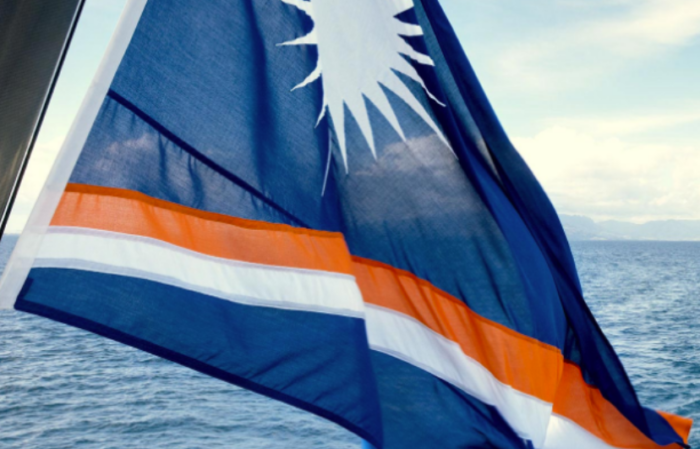
The Marshall Islands (RMI) is the pragmatic choice for American owners who want the operational advantages of a foreign flag with straightforward US-based administration. RMI’s registry offices in Fort Lauderdale and New York make the process local and convenient. The 2026 Yacht Code, in force from 1 January 2026, positions RMI as the leading flag for innovative new builds, including hybrid and alternative-fuel vessels.
Flagging with RMI directly affects how ownership is administered. Documentation, compliance, and ongoing management are handled without the need to coordinate across the Atlantic—and without the offshore corporate layers that sometimes accompany Cayman structures.
In addition, enhanced safety requirements now apply to all vessels of 500 GT and above.
Mandatory fire safety provisions govern spaces used to store or charge lithium-ion equipment—a direct response to high-profile onboard fires involving tenders and water toys in 2024 and 2025. Revised hull construction and stability standards reflect current build practices. Updated helicopter landing area requirements address the growing proportion of large yachts specifying heli-ops as standard.
A yacht specifying LNG or hybrid propulsion needs a flag state that can certify IGF Code compliance at survey. RMI’s alignment makes that simple, though not every registry can say the same, and reflagging at the build stage is a problem worth avoiding.
What the YET programme offers, and where it falls short
Can a private superyacht generate charter income without converting to commercial registration?
The Yacht Engaged in Trade (YET) programme, available under the Cayman Islands and Marshall Islands flags, allows a private yacht of 24 metres or more to charter up to 84 days per calendar year without converting to full commercial status. Operations are currently cleared for France, Monaco, and select Mediterranean waters. The US flag has no equivalent dual-use category.
However, the 12-passenger limit applies throughout—a constraint that shapes how a charter programme can be structured. And while France and Monaco are cleared, the programme does not extend to the Caribbean; an owner splitting time between the Mediterranean and the West Indies needs a clear view of which waters fall inside and outside YET’s scope.
The compliance cost is the other variable. YET requires full commercial standards at all times—ISM, MLC, ISPS, MARPOL—regardless of whether the vessel is actively chartering.
What federal documentation does not protect you from
Does US documentation shield a yacht from state tax?
No. USCG documentation establishes nationality, not tax residency. Following the February 2026 Supreme Court ruling on tariffs, the question of US importation fees is still unanswered, and state-level “use tax” remains a trap. In Florida, this is capped at $18,000, while a foreign-flagged vessel on a US Cruising Permit (managed via Customs and Border Protection’s [CBP] ROAM app) can defer these costs for up to one year, provided it adheres to the mandatory 15-day departure rule.
Florida’s use tax is assessed on the yacht’s appraised value. A $100 million yacht overwintering in a South Florida marina without paying import duty may face a liability running into millions.
The Cruising Permit defers that exposure rather than eliminates it. Annual renewal requires active programme management, and scrutiny by CBP in Fort Lauderdale and Miami has tightened. A yacht with any visible charter presence online—even one operating strictly privately in US waters—has been refused on that basis.
The alternative is more direct: paying the 1.5% import duty on the hull’s appraised value unlocks free circulation in US waters and, critically, the ability to charter. On a $50 million vessel, that is $750,000—not a small figure, but one that buys more freedom and eliminates the annual permit management cycle.
Which option should you choose?
The question of where to flag your vessel is primarily a question of where you want to use it. It should be made alongside the choice of owning structure, crew strategy, and intended itinerary—not after them, and not in isolation.
For the yacht owner whose programme is American—a settled US crew, primarily US waters, no intention to charter internationally—the US flag is a coherent choice with real advantages; think the tax depreciation benefits, the $18,000 sales tax cap, and the diplomatic protection it affords. But for the owner who wants access to the full international crew market and the flexibility to charter outside US waters, the Cayman Islands or the Marshall Islands are the more considered options.
Unsure which flag suits your yacht’s programme?
Hill Robinson reviews flag-state suitability as part of its ongoing management advisory, accounting for the owner’s changing itinerary, crew structure, and commercial intentions throughout the vessel’s life. Contact us for more information.
Keep reading
Related news
Editorial
19 May 2026
The superyacht industry is finally taking crew welfare seriously. Here’s what that means in practice.
For five years, Kayleigh Liddell has been making the same argument: that superyacht management companies need to think about crew the way good employers…
Read more
Editorial
18 March 2026
The crew guide to Palm Beach International Boat Show 2026
If you’re berthed at Palm Harbor Marina, you’re already at the centre of the Palm Beach International Boat Show (PBIBS). The Superyacht Show runs…
Read more
Editorial
16 March 2026
Is the superyacht industry finally growing up? Kevin Laverty thinks so
There’s a moment at every industry event when the room either confirms what you genuinely expected, or genuinely surprises you. For Kevin Laverty, Director…
Read more